Your Cart is Empty
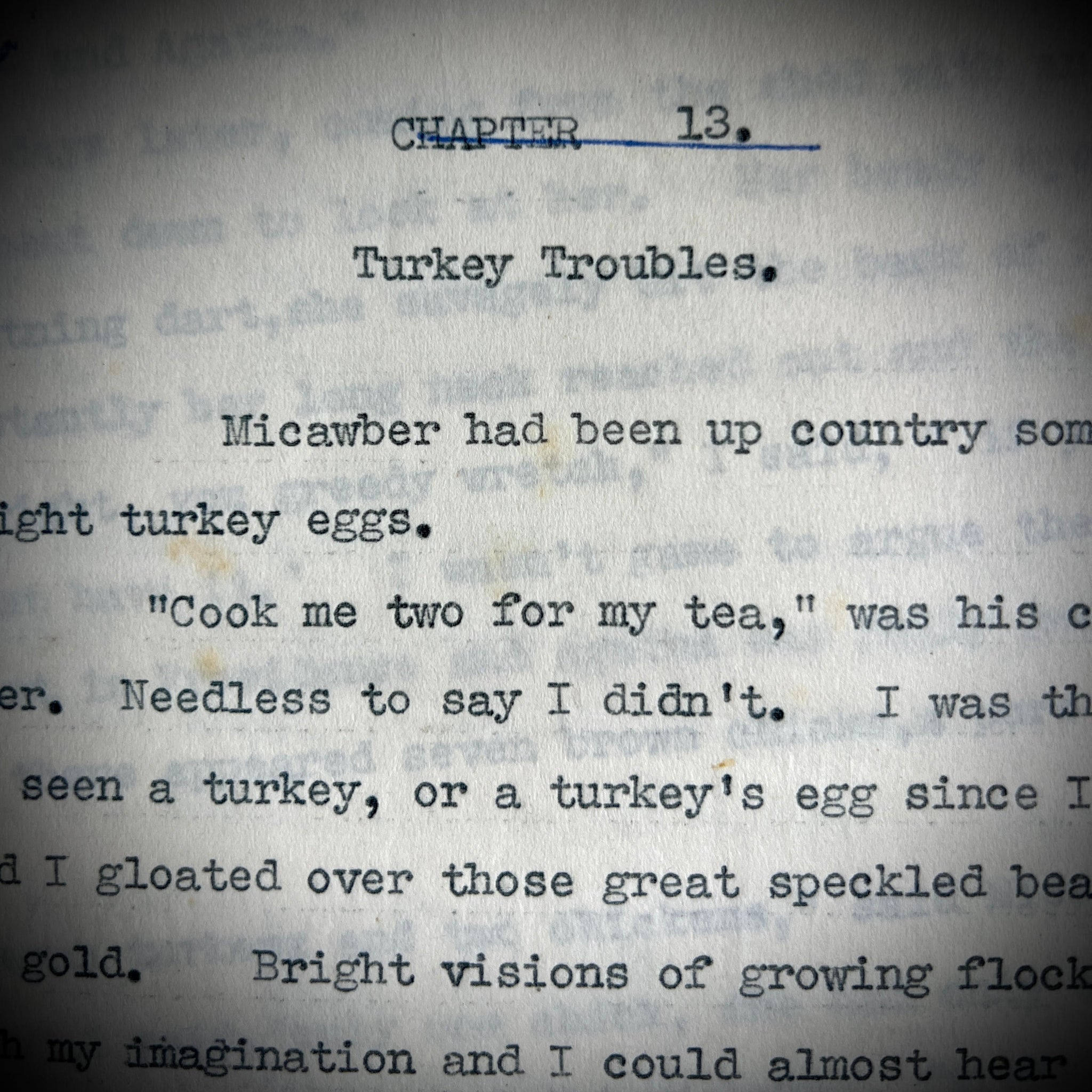
My great-grandmother, Jennifer Rendall, wrote a weekly column for the New Zealand Home Journal, signed simply “Aunt Jenny”. With Christmas on the way, here’s her tale of the turkeys. – Rewa
Micawber had been up country somewhere and brought home eight turkey eggs.
“Cook me two for my tea,” was his command as he handed them over. Needless to say I didn’t. I was thrilled to the toes, I hadn’t seen a turkey, or a turkey’s egg since I was quite a small child and I gloated over those great speckled beauties like a miser over his gold. Bright visions of growing flocks of turkeys floated through my imagination and I could almost hear the joyful chink of much silver dropping into my coffers.
The fowl house was full of clucking hens, so I made a hurried selection and introduced her to a comfy box and those treasured eggs. One look was enough for her and with terrified squawks she fled. One hen after another I tried, with the same dire result, and as day after day passed I despaired.
Then, one morning, to my great delight, Agatha, the big Rhode Island hen began to ruffle her feathers and get fussy. Agatha would usually sit on anything from a stone to a turnip, so I didn’t think she would be likely to turn down anything in the shape of eggs.
She turned the queer looking things over and over, while I watched with bated breath, then with contented, throaty cluckings she settled comfortably down on them.
“You will not get anything out of those eggs now,” protested Micawber, “far better to let me eat them.”
“That remains to be seen,” I retorted, “I’ll just trust to Providence – and Agatha.”
Some days later, coming from the shed with an egg in my hand I stopped and bent down to look at her. Her beady eyes spied the egg and with a lightning dart, she savagely bit the back of my hand. The egg dropped and instantly her long neck reached out and the loot was drawn under. “All right, you greedy wretch,” I said, “if you want more than I do, just have it.” I wasn’t game to argue the point with her.
My trust in Providence and Agatha was fully justified, for in the course of time there appeared seven brown chicks, a pure white one and a black!
“Seven turkeys and two chickens,” said Micawber.
“No,” I said, “only one chick, she had only one hen egg.”
“TWO CHICKENS,” insisted Micawber, firmly, and I let him have his way, knowing that time would prove that I was right.
However, Agatha treated them all alike, and proceeding on advice from a neighbour who was supposed to know all about it, I tied the protesting hen under a tree.
“See that they are kept dry, if you get them over the first fortnight they will be all right,” I was told, and believe me, I scarcely took my eyes off those fowls during those two weeks and was just beginning to breathe freely, when first one, then another developed a swollen head. Their cheeks were so blown out that they couldn’t see their food, and I was in despair.
As I was carefully examining one limp, hungry chick a small boy came through the garden gate and watched me with interested eyes.
“Them chicks has diseased heads,” he volunteered at last.
“You’ve got a diseased head,” I retorted, crossly. “Run in, Barbara, and get me a needle, I’m going to see what is inside this ‘swell.’” Before she returned, however, the chick suddenly struggled violently, and looking down I discovered that, gently stroking the little head, the bubble had burst, chicky spied his food and was keen to get at it. It didn’t take long then, to get the others going too.
“We tried turkeys once,” went on the small boy, “and when they were about a month old, they every one died, you won’t get them over a month.”
That meant, of course, that I held my breath for two more weeks, then the biggest one dropped sadly. “That’s bad,” said another Job’s comforter, “I’ve always heard that it was a very critical time when they got about six weeks old.”
“These,” I said, exasperated, “are critical ALL the time.” In the course of a day or two that chick died and was sorrowfully buried. When another one put its wings down I was in despair.
“Why not look up the ‘Stock Doctor’?” suggested Barbara. Happy thought. Down came the great book and over flew the pages. Poultry. Ducks, geese, hens, turkeys.
There it was. “When the poults droop, give them –” well, it was something I had never heard of before. Clasping the book I raced to the barn where Micawber was mending some machine. “Look,” I cried eagerly, “that’s what you give sick turkeys, I want some, quick.”
He pushed his hat back, looked long at the book, then, “Do you think I’m a perambulating chemist’s shop?” he enquired. “I don’t know anything about the stuff, you should have let me eat those eggs,” and he turned to his tinkering again. I sat down on a book and read further. ‘Give them boiled rice to eat.’
“Thanks be,” I ejaculated fervently, “at least I can do that.”
Carefully, the rice was boiled and set in the sink to cool while I went out to see how the invalid was, and tell it salvation was coming. When I went back Micawber was sitting on the bench, the rice pot in one hand, a spoon in the other, the cream jug and sugar basin beside him and with the spoon he carefully chased the last fugitive grain in the pot.
“Oh, don’t, don’t,” I howled, dashing at him and snatching the now empty pot. “Oh, you haven’t eaten it!”
“Why, was there anything wrong with it?”
“No, there wasn’t, but I wanted it for my turkeys,” I wailed.
“Well, I like that,” he retorted as he sidled to the door. “Here’s a woman starves her husband and gives his last mouthful to the blinkin’ fowls,” and grabbing his hat, he fled.
I boiled some more, but the book didn’t say what to do if the chick refused to eat the rice, and at sundown we dug another grave in the rose garden.
After we had buried the fifth, things got better. The black one, the white one and the two brownies decided to live. In the course of time the black one grew into a great, heavy rooster, and met with sudden tragedy one morning when the chaff cutter came in unexpectedly and there was no meat in the house. The white one developed into a light grey turkey of huge dimensions.
“Three blinkin’ bubbleys,” said Micawber in disgust, “you should have let me eat those eggs.”
“They’re NOT all gobblers, they can’t be,” I said, and day by day I watched them anxiously. But I found, to my sorrow, that they COULD be, and were.
Obediently they trailed about behind their Rhode Island mother, and it was most amusing to see her bossing her great, lumbering sons. I was tremendously proud of my great turkeys, and fiercely resented Micawber’s constant suggestions about selling them.
“It’s no use keeping all those useless creatures,” he kept protesting, “sell two, and buy some hens. You would have been far better to have let me eat those eggs.”
Then one day, poor Agatha had a sick turn, and when I wasn’t looking, her three cannibal sons literally tore her to pieces. Then in deep disgust I hurried the two brown ones off, disregarding all warnings that the light coloured one was a mongrel, and for a whole year, Douglas, the white one, roamed, lonely and aloof about the yards and paddocks.
On a trip into the bush country, Micawber saw a flock of turkeys, promptly bought two hens and brought them home to me. I called Douglas up to see his harem as Micawber carefully lifted them out of their box. ‘The Dainty Ladies’, we immediately christened them, charmed with their dainty ways.
But Douglas was not in the least impressed and stood looking on contemptuously. The Dainty Ladies minced closely to him, one on either side, and gently pecked his head. Douglas held his head as high as possible and looked down his nose at them in silent disdain.
“Huh,” grunted Micawber, “the hussies. That will let you see what we men have to put up with.” Douglas apparently was a confirmed woman hater, and when the Ladies got too familiar, he turned on them and punished them so severely that they kept well away from him. By and by I found that they had made a huge nest, and in it were thirty eggs; they sat together and were preparing to cluck when I found them.
“Surely I’ll get some to eat, now,” said Micawber in deep satisfaction.
“Indeed you won’t, I’m going to let them sit. I want lots of turkeys,” I told him. He laughed loud and long.
“Nary a chick will you get out of those eggs, better let me eat them.”
“You said that before,” I reminded him, much offended. “I’ll trust to Providence again – and the Dainty Ladies.”
“Well,” he laughed, “I don’t think it’s a fair deal to saddle Providence with Douglas’s laxness.”
“Don’t be low,” I retorted.
Seven weeks those turkeys sat, and almost every day he enquired after them; then one morning, in deep disgust, I tumbled them off the nest and made an omelette against a blue gum with those thirty eggs.
Good thing Micawber doesn’t come round here very often, I thought, and not ten minutes later I saw him coming from that direction with a huge grin on his face.
Hastily I thought up a few smart things to say when he teased me, but there was no trace of a smile when he came to the door. Those wretched birds chose just that minute to come staggering by. “The ladies look a bit thin after their long confinement,” he remarked kindly, “you’ll have to feed them up a bit.” Hastily I marshalled my cutting replies and waited for him to go on.
“Got the factory cheque this morning, like to come to Town with me?” Phut! went all the wind out of my sails. “Yes, thank you,” I murmured meekly.
– Aunt Jenny
Whatever’s on your Christmas table this year, I hope it behaves better than Jennifer’s turkeys. If you’re looking for a gift for a maker in your life, our starter kits have everything in the box. Email me if you’d like help choosing.


A story from Aunt Jenny's column in the New Zealand Home Journal: the hat she couldn't forget, and how it finally became hers.


First made over 30 years ago, last made 10 years ago - Jack is back even better than before.
Due to popular demand Ashford have reintroduced the eight shaft, ten treadle 97cm (38") weaving width, folding Jack loom. Create your own beautiful fabrics with ease on this strong compact loom. In production now and ready for shipping on June 16th don't miss your chance to spend time with Jack.